Custom fonts are one of the fastest ways to make a brand feel unmistakably itself. Whether you’re building a new identity, refreshing a product line, or scaling a design system across teams, a custom typeface delivers consistency, flexibility, and a voice that belongs entirely to your own brand.
When you work with The Type Founders, you commission custom work directly with any of our experienced foundries. You’re collaborating with specialists whose typefaces are already in use across editorial, packaging, apps, enterprise platforms, and global brands. You’re not hiring a generalist. You’re working with type designers who have built fonts at scale, for real conditions.
What custom fonts can mean, and which option is right
Custom font is a catch-all term covering three very different approaches — each with its own timeline, cost, and level of ownership. Understanding which one fits your situation before you brief a foundry will save significant time and money.
- Customization. Modifying an existing commercially available typeface, with the foundry’s permission, to better fit your needs. Faster and less expensive than starting from scratch.
- Bespoke typeface. An entirely new design built for your brand, with letterforms, weights, and features tailored to your use cases. The most expensive and time-intensive option.
With thousands of typefaces available, the right font is often closer than you think. A good match found through careful research can be just as distinctive as something built from scratch. When an existing typeface gets you 80% of the way there, customization closes the gap without the cost or timeline of a full bespoke project. Reserve bespoke for when you genuinely need something no existing typeface can provide: a full family system, long-term brand ownership, or performance requirements that retail fonts can’t meet.
Custom font stakeholders: who’s actually involved.
Creating a custom font is a deeply collaborative process that brings together stakeholders from both the client and foundry sides.
On the client’s side, the core team typically includes brand strategists and creative directors who define the typographic vision, marketing leads who understand how the font needs to perform across campaigns, and digital and print designers who will live with the typeface day to day. Legal and procurement teams may enter the picture for licensing agreements and usage rights.
On the foundry’s side, the process is led by type designers who translate the brand’s personality into letterforms, supported by project managers who keep timelines and feedback loops on track. Depending on scope, type engineers may also ensure the font performs flawlessly across digital environments, handling variable font axes, hinting for screen rendering, and cross-platform compatibility. When these voices align early, the result isn’t just a functional typeface. It's a brand asset with genuine depth and longevity.
Step-by-step timeline and project phases: how to get a custom font done
1) Define what the font needs to do
Before you settle on a direction, clarify the functional requirements. Common questions to answer:
- Are you starting from an existing typeface or do you need an original design?
- Where will the font be used — web, app UI, print, packaging, signage, video?
- At what sizes will it render — large display, small UI, body text?
- What languages and scripts are required (e.g., Extended Latin, Cyrillic, Greek)?
- What’s the tone: classic, modern, warm, technical, editorial, playful?
- What OpenType features do you need — small caps, oldstyle figures, tabular numbers, ligatures?
- Do you need roman, italic, or both?
- When do you need delivery, and in what file formats?
2) Choose the right custom font partner
The market for custom fonts is vast and includes a lot of options including independent type designers, boutique foundries, and large multi-national companies — each with different specializations and price points. At The Type Founders we’re home to iconic foundries and studios with distinct voices including Carter & Cone, Mark Simonson Studio, Ivy Foundry, and many more. The goal is to match your brief to a team whose strengths align with your brand.
If you already have a few reference typefaces you love (or don’t), we want to see them — those examples help the foundry understand the direction quickly.
3) Decide on the build: retail-ready font vs. bespoke font vs. custom font
A practical way to choose:
- Go retail. With so many typefaces available, an existing font is often the right choice. Retail fonts are tested for widespread use and work at any operational scale. The choice can feel overwhelming, but the type experts at The Type Founders can help you find the right one for your brand.
- Go custom. If you like an existing typeface but need adjustments — alternate glyphs, brand-specific numerals, tighter spacing, additional weights, language expansion — it gets you exactly what you need without starting from scratch. It takes a little longer and costs a bit more than retail, but the result is tailored to your brand.
- Go bespoke. If you need a unique voice, a full family system, or long-term brand ownership, bespoke is the option that delivers it. The investment is significant and timelines can stretch to months or years — but no other path gives you a typeface that is entirely your own.
4) Align on scope, timeline, and licensing for the custom font
Custom type projects vary widely, so it helps to align early on.
- Scope. Styles (weights/italics), character set, features, variable font needs
- Timeline. Concept → design → spacing/kerning → testing → final delivery
- Licensing. Where the font can be used (web/app/print), number of users, exclusivity, and whether the font will be distributed to partners
Find out how The Type Founders helps enterprise clients achieve the best results.
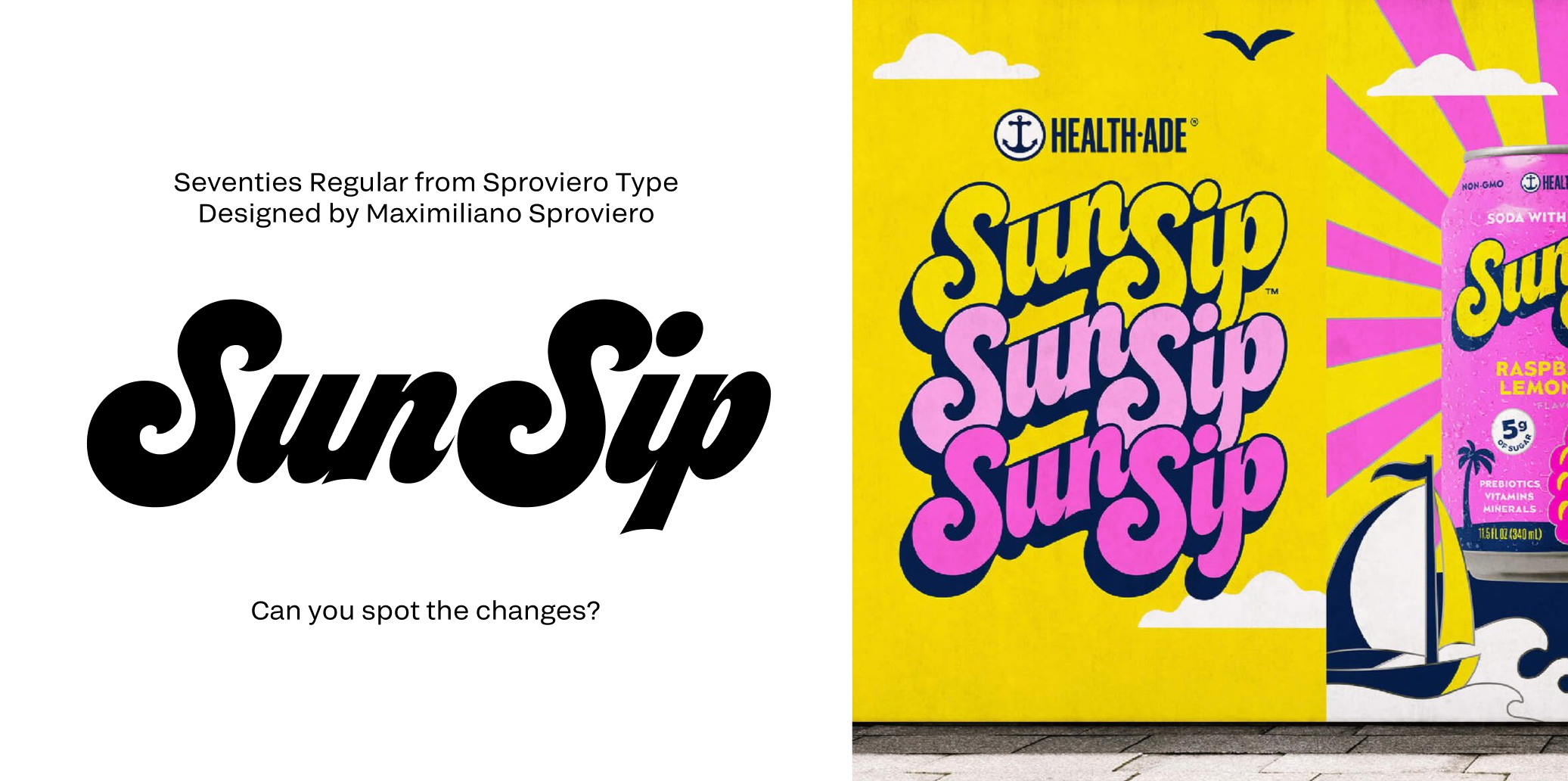 The Type Founders work with with Flock for Health-Ade’s SunSip brand used Sproviero Type’s Seventies as the starting point for a custom typeface. The modified letterforms were tailored to create the logo’s specific proportions and personality. You can read more here.
5) Review font proofs and test the font in real layouts
The best custom fonts are designed in context. Bring real content — not Lorem Ipsum — whenever possible. Expect rounds of review where you test:
- Headlines, body copy, UI components
- Numbers (tables, pricing, dashboards)
- Accessibility requirements for your specific needs
- Readability across different sizes, weights, widths, and styles
- Rendering across browsers and operating systems
6) Deliverables, file formats, and implementation
If you’re using the font across many teams, build a straightforward internal rollout plan so everyone is working with the same fonts. A professional delivery package typically includes:
- Font files (often OTF/TTF for desktop, WOFF/WOFF2 for web)
- Style guide (recommended sizes, spacing, do/don’t examples)
- Naming conventions and versioning
- Guidance for product teams and external partners
What to include in a custom font brief (copy/paste)
Providing this information helps the process. Use this as a starting point and adjust for your project:
- Brand / product. Name, category, and any existing brand guidelines
- Audience. Who you’re designing for and where they’ll encounter the font
- Use cases. Web, app, print, packaging, signage, video
- Tone keywords. Confident, human, precise, editorial, playful
- Must-have features. Languages, numerals, small caps, ligatures
- Nice-to-haves. Secondary features you’d welcome but won’t block the project
- References. 3 fonts you like and why, 3 you don’t and why
- Timeline. Target delivery date and any hard deadlines
- Budget range. Approximate range helps foundries scope accurately
- Approval stakeholders. Who needs to sign off and at what stages
Why partner with The Type Founders on a custom typeface for your typography?
The Type Founders exists to support and grow the craft of type design — pairing clients with exceptional foundries and helping projects move from idea to production-ready fonts without losing momentum.
Working with us, you get:
- Direct access to our family of renowned foundries with proven real-world experience
- A process built for real-world usage — not just how they look in specimens
- Options across bespoke design, customization, and licensing
- And guidance from our experts through every step along the way
FAQs about custom fonts
How much does it cost to design a custom typeface
Custom font pricing depends on scope: number of styles (weights/italics), character set (languages/scripts), and features (like small caps or variable fonts). A small customization can be far less than a full bespoke family.
When should you commission a custom font instead of licensing one?
Commission a custom font when your brand needs to differentiate in a way competitors can’t copy — and when you also need enterprise-ready control (multiple teams/products, global language support, UI performance, custom features like numerals or variable fonts). If an existing typeface already matches your brand and the license covers your real usage, licensing is usually the faster, simpler route.
How long does a custom typeface take to produce?
Timelines vary by complexity. A focused project can take weeks, while a full family designed for multiple languages and extensive testing might take months or even years! The fastest way to stay on schedule is a clear brief and quick feedback cycles.
Can you customize an existing font instead of starting from scratch?
A font cannot be customized by a third party (unless permission has been granted). Many brands begin with a typeface they already like and commission adjustments — alternate glyphs, expanded language support, additional weights, or refined spacing/kerning.
Do I own the custom font?
Ownership and usage rights depend on the agreement. Some projects are licensed for specific uses (web/app/print), while others include broader rights or exclusivity. It’s best to align on licensing early. At The Type Founders, we’ve brought simplicity and transparency to the licensing process so you can feel good about the agreement you’re signing.
What files will I receive?
Most projects deliver desktop font files (OTF/TTF) and web files (WOFF/WOFF2). If you’re building digital products, ask whether a variable font is a good fit for your needs in terms of performance and flexibility.
What's the difference between a custom and a bespoke typeface?
A custom font is modified specifically for you. A bespoke font is designed specifically for you.
How do I start a custom font project with The Type Founders?
Reach out with a well-crafted brief (as the one above in the article) that includes your audience, use cases, tone keywords, must-have features, nice-to-haves, references, timeline, and budget range. We’ll help match you with the right TTF foundry partner and define the scope, timeline, and licensing.